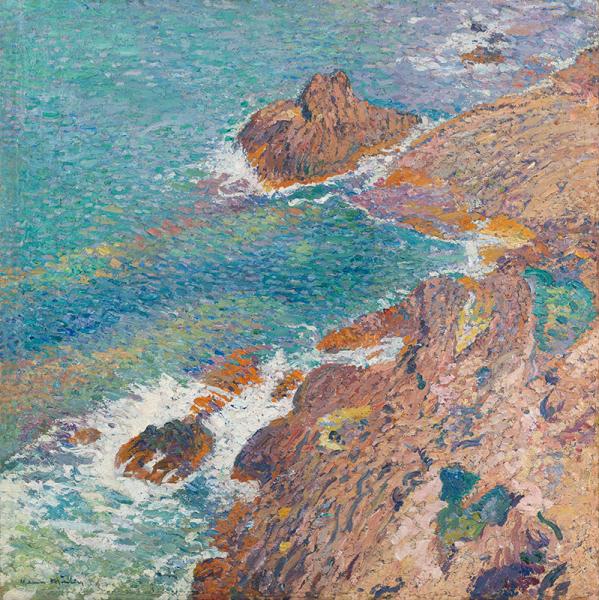
Rochers roses aux reflets d'or dans la mer à Collioure, circa 1925
Oil on canvas, signed lower left.
81 x 80 cm
Provenance:
Estate of Cyrille Martin
Galerie Alexis Pentcheff, Marseille
Private collection, Belgium
Related work:
Marine bretonne, before 1930
Oil on canvas, 80 × 79 cm
Musée des Beaux-Arts de Quimper, inv. 31.1.1.
Certificate of authenticity issued by Cyrille Martin.
With these bare rocks emerging from the sea, Henri Martin offers a composition stripped of all anecdote and all human presence, standing in marked contrast to the large narrative cycles he conceived for public monuments.
The figures he usually studies with such precision in their attitudes have no place here, in this exclusively elemental view.
Only two protagonists command the painter’s attention: the sea and the rocks.
Yet one must not overlook the light, which sculpts this fragment of nature, imposing itself upon the artist as an autonomous and powerful motif.
At once shifting and reflective, the sea is constructed through a rich palette ranging from mauves to greens, and encompassing a wide variety of blues.
The morning sun is perceptible in the yellow, orange, and pink reflections that flicker across the surface.
Meeting the rocks, the water turns to white foam. This is certainly not a storm, yet its force is present, contained.
The brushstrokes are directional and superimposed, suggesting both the internal movement of the water and its reflective capacities.
The rocks, for their part, are treated with an equally broad palette, combining violets, greens, touches of pink, blues and yellows, and even areas of vivid orange where the sea bites into them.
Rendering the full range of light as it plays across the rock’s fissures, the colour is applied in thick, layered strokes that sculpt the masses.
Varying in orientation, form, and length, the brushstrokes introduce a visual pulse while simultaneously constructing the landscape. The material becomes relief.
Henri Martin explored this maritime motif at length.
This iconography, little known within the artist’s corpus, is nevertheless essential, as it reveals an artist who relinquishes anecdote in order to confront his sensibility with the brutality of the elements and their essential materiality.
It also allows us to penetrate, without artifice, the very core of Henri Martin’s technique.
Several surviving works present the same plunging viewpoint over this stretch of coastline, as though the painter had sought to extract a sample of the shore in order to observe it more closely. The effects of light are always different.
Preserved in the Musée des Beaux-Arts de Quimper, to which it was donated by the artist in 1930, a comparable view adopts the same square format, reinforcing this sense of the painter’s natural sampling. The site is identified as Brittany, a conclusion supported by the treatment of light.
Is it because the presence of the sun is suggested through its reflections that this painting, like several others in the series, bears a reference to Collioure in its title?
Whether in Brittany or on the Côte Vermeille, the precise location where Henri Martin observed his motif ultimately matters little.
What mattered was confronting, at a given point, the telluric forces at work.
If Monet, in similar motifs, observes the atmospheric variations of the sea, Henri Martin, by contrast, summons in his painting the telluric forces themselves—their contained power and their capacity to generate matter.